

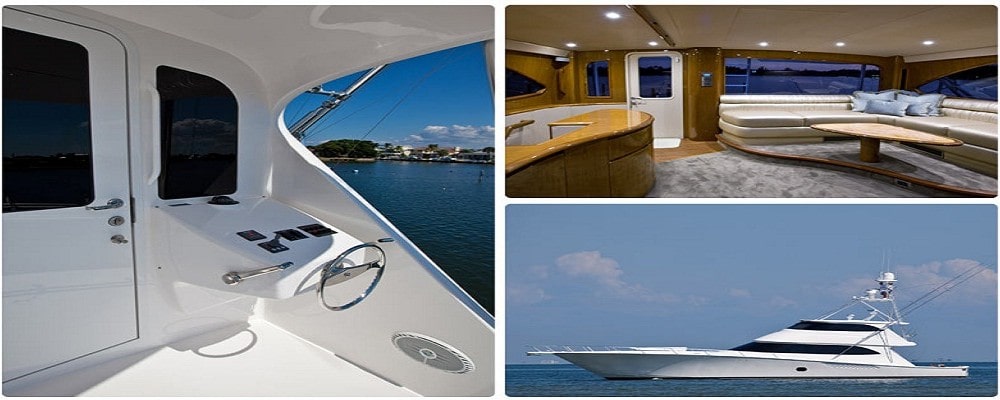
By Robert Lama, President — Miami International Yacht Sales | Updated November 2026
Not all luxury yachts depreciate equally. Some brands lose 40–50% of their value in five years. Others retain 60–70% — or more. After 14 years of buying and selling yachts in Miami’s pre-owned market, the pattern is consistent: the brand matters almost as much as the condition when it comes to resale value.
This guide covers both sides of the equation: how fast yachts actually depreciate year by year, which brands minimize that loss, what the IRS allows for tax depreciation on a business-use vessel, and a free valuation request so you can apply these principles to a specific yacht you are considering.
📞 Want a market valuation on a specific pre-owned yacht? Call Robert Lama: +1-305-857-8939
The Yacht Depreciation Curve: How Fast Do Yachts Lose Value by Year?
Yacht depreciation does not follow a straight line. It follows a steep early curve that flattens significantly after year three — and understanding this curve changes how you evaluate the buy-new vs. buy-used decision.
According to Boatzon’s analysis citing BoatUS market data (April 2026), production boats lose approximately 10–15% of value in year one alone — before the boat has accumulated meaningful hours. By year five, cumulative depreciation reaches roughly 20–30% on well-maintained production motor yachts. By year ten, most production vessels have depreciated 30–50% from their original new price, with the specific outcome depending heavily on brand, model, maintenance documentation, and the South Florida used yacht market at the time of sale.
Three factors make yacht depreciation behave differently from automobile depreciation:
- Build quality dominates long-term value. A production Azimut and a custom Feadship purchased new at different price points follow entirely different depreciation trajectories — the Feadship’s handbuilt construction retains value at a meaningfully higher rate past year five.
- Maintenance documentation has outsized impact. A well-documented vessel with survey records, engine service logs, and receipted yard work consistently sells for 10–20% more than an equivalent undocumented example. The documentation is not just paperwork — it removes uncertainty from the buyer’s calculation.
- The 3–5 year entry window. The steepest portion of the production yacht depreciation curve falls in years one through three. Buyers who acquire a well-maintained production motor yacht at year three to five typically capture the worst of the first-owner depreciation while getting a vessel still in excellent mechanical condition — often the best cost-per-nautical-mile position in the market.
| Age | Production Yacht (Azimut, Ferretti, Princess) | Premium / Semi-Custom (Sanlorenzo, Westport) | Custom Superyacht (Feadship, Lürssen) |
|---|---|---|---|
| Year 1 | 10–15% loss | 5–10% loss | 3–7% loss |
| Year 3 | 25–35% cumulative loss | 15–25% cumulative loss | 10–18% cumulative loss |
| Year 5 | 35–50% cumulative loss | 25–35% cumulative loss | 18–28% cumulative loss |
| Year 10 | 45–60% cumulative loss | 35–45% cumulative loss | 30–40% cumulative loss |
| Year 15+ | Stabilizes — condition and refit history dominate price | Stabilizes — documentation premium grows | Often stable or appreciating with major refit |
Table based on Robert Lama’s 14 years of Miami brokerage transaction data combined with BoatUS market benchmarks (cited by Boatzon, April 2026). Individual vessels vary significantly by condition, documentation, and market timing. Contact MIYS for a vessel-specific valuation.
What flattens the depreciation curve after year five? Two things: the first-owner premium has fully unwound (the market no longer pays extra for newness), and the vessel has established a real-world maintenance track record. A ten-year-old Sanlorenzo with complete service records, a recent refit, and low engine hours may trade at a meaningfully smaller discount to a five-year-old equivalent than the raw age difference would suggest.
Do Yachts Hold Their Value? — The Honest Answer
Most production yachts depreciate — but some hold their value significantly better than others, and a small number can actually appreciate. The answer depends entirely on which category the yacht falls into.
Yachts that hold their value well: Custom and semi-custom builds from low-volume yards — Feadship, Sanlorenzo, Westport — lose far less value in the first five years than production equivalents at similar price points. In the sportfishing segment, Viking Yachts and Bertram consistently hold value better than any US or European competitor. Well-maintained Bertram 31s from the 1960s and 1970s now trade at prices that exceed what they cost new in inflation-adjusted terms — genuine collector appreciation. The Riva Aquarama is the most cited example: classic examples from the 1960s sell for multiples of their original price today.
Yachts that depreciate faster: High-volume production motor yachts — particularly in the 35–55 foot range from Italian and British builders — follow the steepest depreciation curves. This is not a quality statement; it is a supply dynamic. When thousands of units exist in the used market simultaneously, pricing is compressed.
Do boats hold their value the same way? No — smaller powerboats and fishing boats depreciate faster than motor yachts in most cases. The yacht segment benefits from lower production volumes and higher buyer sophistication, both of which support secondary market pricing. Performance sportfishing brands (Viking, Bertram) are the notable exception: these depreciate more slowly than many motor yachts of equivalent age.
Can a yacht appreciate in value? Yes, in three scenarios: a classic model with recognized collector status (Bertram 31, Riva Aquarama, early Hatteras), a well-specified vessel that received a comprehensive refit in a rising market, and ultra-limited production custom builds (a Feadship at 15–20 years old with documented provenance often holds value better than its replacement cost). For most production motor yachts in the 2010–2020 vintage range, appreciation is not the realistic planning assumption — holding 55–70% of value over 5 years is the realistic best case in a well-maintained, well-documented example from one of the top 10 brands ranked below.
What Makes a Yacht Hold Its Value? — 5 Key Factors
Before ranking the brands, understanding what drives resale value is essential. Buyers who grasp these factors make better acquisition decisions — and better exit decisions when the time comes to sell.
| Factor | Why It Matters | High-Value Signal |
|---|---|---|
| Limited production volume | Scarcity keeps secondary market prices firm | Custom yards (Feadship, Sanlorenzo) vs high-volume builders |
| Brand loyalty and community | Loyal buyers return — creating sustained demand | Viking, Bertram owner communities in South Florida |
| Build quality and longevity | Quality construction holds up — fewer deferred repair discounts at sale | Steel/aluminum hulls (Feadship, Westport composite) |
| Service network strength | Buyers pay more when service is accessible | Brands with active US dealer + service networks |
| Design longevity | Timeless aesthetics don’t look dated at resale | Riva, Sanlorenzo — design that ages gracefully |
The brands that score highest on all five factors consistently outperform in the pre-owned market. The rankings below reflect 14 years of Miami brokerage data, YATCO and YachtWorld price tracking, and direct transaction experience across all ten brands.
Top 10 Used Yacht Brands That Hold Their Value — Ranked
1. Feadship — Best Overall Resale Value (Superyacht Segment)
Feadship is the gold standard of superyacht resale value. No other production or custom builder consistently retains value at the same level — driven by three factors that no competitor can easily replicate: fully custom construction (no two Feadships are identical), extraordinarily limited annual output (3–5 vessels per year), and sustained demand from UHNW buyers who specifically seek out Feadship pedigree.
| Metric | Feadship Data |
|---|---|
| 5-year value retention | 70–80% of original price |
| 10-year value retention | 55–65% of original price |
| Annual production | 3–5 vessels per year |
| Price range (pre-owned) | $15M – $300M+ |
| Best-holding models | Custom builds 50–90m with strong design heritage |
| Miami market liquidity | Moderate — sells internationally, not primarily in Florida |
Robert Lama’s take: Feadship is the safest long-term value store in the superyacht segment. If you buy a well-maintained Feadship at a fair price, you will rarely lose significantly on resale — and you may break even or improve on your entry price in a strong market. The challenge is that the entry point starts at $15M+ and there are rarely more than 20–25 Feadships on the open market globally at any given time. For off-market Feadship availability and current pricing, call Robert Lama directly: +1-305-857-8939. See our complete Feadship builder comparison for more context on how the yard sits relative to Dutch and German competitors.
2. Sanlorenzo — Best Resale in Italian Semi-Custom Segment
Sanlorenzo is Italy’s most respected boutique semi-custom builder — and its pre-owned values reflect that positioning. Sanlorenzo deliberately limits annual production volume even though it could build more, maintaining scarcity in the secondary market that Italian high-volume competitors like Azimut cannot match.
| Metric | Sanlorenzo Data |
|---|---|
| 5-year value retention | 60–70% of new price |
| Best segment | 40–62 meter range (SL102, SL106, SX112) |
| Price range (pre-owned) | $1.5M – $30M+ |
| Design longevity | Excellent — understated aesthetics age well |
| Miami availability | Good — growing Florida presence, active pre-owned market |
The Sanlorenzo SX series — particularly the SX76, SX88, and SX112 — has become one of the most sought-after modern designs in the 25–35 meter production semi-custom market. Hybrid propulsion options and flexible deck use make these models attractive to the next generation of buyers, supporting stronger resale values over time.
3. Viking Yachts — Best Resale in Sportfishing Segment
In the 35–90 foot sportfishing and convertible segment, Viking Yachts has the strongest resale value of any brand — American or European. Viking is family-owned (New Gretna, New Jersey, since 1964) and has never been sold to a corporate conglomerate. That consistency of ownership translates into consistency of build quality and brand identity, which the secondary market consistently rewards.
| Metric | Viking Data |
|---|---|
| 5-year value retention | 65–75% of new price |
| Best-holding models | Viking 62, 68, 80 Convertible — tournament-rigged |
| Price range (pre-owned) | $150K – $4M+ |
| Miami market liquidity | Very high — tournament fishing community, active Bahamas use |
| Maintenance advantage | Parts and service widely available in South Florida |
For Miami buyers who offshore fish seriously, Viking is the benchmark brand. The tournament fishing community in South Florida specifically targets Viking convertibles — creating sustained buyer demand that keeps pre-owned prices firm. A well-maintained Viking 62 Convertible from 2015–2019 is among the most liquid sportfishing assets in the Florida market.
4. Ferretti Yachts — Best Italian Production Resale Value
Among Italian production motor yacht builders — Azimut, Ferretti, Princess, Sunseeker — Ferretti consistently retains the most value over 5–10 years. The reason is structural: Ferretti’s semi-displacement hull produces a heavier, more durably built vessel than comparable Azimut planing hulls, and interior finish quality ages more gracefully, reducing the cosmetic discount buyers apply to older examples.
| Metric | Ferretti Data |
|---|---|
| 5-year value retention | 55–65% of new price |
| Best-holding models | Ferretti 780, 850, 920 — Skydeck configurations |
| Price range (pre-owned) | $500K – $10M+ |
| Miami availability | Excellent — largest Italian brand presence in South Florida |
| vs Azimut at 5 years | Ferretti retains ~5–8% more of original price |
The Ferretti 780 Skydeck (introduced 2021) is already showing strong early resale signals in the Miami market — the additional deck space configuration is consistently cited by buyers as a premium they are willing to pay, supporting secondary values. See our detailed Azimut vs Ferretti comparison for a full head-to-head on resale data.
5. Azimut — Best Volume Brand for Resale Liquidity
Azimut does not retain value as strongly as Ferretti or Sanlorenzo percentage-wise — but it sells faster. The brand’s broad recognition, high production volume, and wide buyer awareness mean that a well-priced Azimut typically moves more quickly than an equivalent Ferretti in the pre-owned market. For sellers who prioritize time-to-sale over maximum exit price, this liquidity advantage matters.
| Metric | Azimut Data |
|---|---|
| 5-year value retention | 50–60% of new price |
| Best-holding models | Azimut Grande 25M, Azimut 78 — upper range holds better |
| Price range (pre-owned) | $400K – $8M+ |
| Miami liquidity | Highest of any Italian brand — widest buyer pool |
| Best for | Buyers planning 3–5 year holds who want easy exit |
Azimut’s ARS hull design (later models) and IPS pod drive systems are also positives for resale — buyers increasingly understand these engineering features and pay for them, which supports secondary values on post-2015 Azimut production.
6. Riva — Best Heritage Brand for Collector Value
Riva occupies a unique position: it is the only major Italian yacht brand with genuine collector value. Classic Riva Aquarama runabouts from the 1960s and 1970s sell today for multiples of their original price. This heritage premium flows forward — modern Riva motor yachts command a brand premium over technically equivalent Ferretti Group siblings that is measurable in pre-owned market data.
| Metric | Riva Data |
|---|---|
| Classic models (pre-1980) | Appreciation possible — genuine collector market |
| Modern models (5-year retention) | 55–65% — premium over Azimut equivalents |
| Best-holding modern models | Riva 88′ Florida, Riva 110′ Dolcevita |
| Price range (pre-owned) | $200K – $12M+ depending on era |
| Miami recognition | Very high — immediately recognizable hull profile |
7. Bertram — Best Sportfish Resale Under $1.5M
In the under-$1.5M sportfishing market, Bertram retains value better than any competitor in the Miami and South Florida pre-owned market. The brand’s deep-V hull design, loyal owner community, and Miami-specific performance credentials create consistent demand that keeps pricing firm — particularly for 40–54 foot models in documented condition.
| Metric | Bertram Data |
|---|---|
| 5-year value retention (modern) | 55–65% |
| Best-holding models | Bertram 46, Bertram 54 — documented with service history |
| Price range (pre-owned) | $80K – $1.5M+ |
| Miami market advantage | Strongest single brand loyalty in South Florida sportfishing |
| Classic models | Bertram 31 — collector category, appreciation possible |
The Bertram 31’s collector trajectory is worth noting specifically. Well-restored 1960s–1970s examples now trade at prices that would have seemed implausible a decade ago — genuine maritime heritage commands genuine premiums. For the complete Bertram story, see our complete Bertram history and buyer’s guide.
8. Westport — Best American Composite Brand for Resale
Westport Yachts (Port Angeles, Washington) produces composite motor yachts in the 112–164 foot range — and holds pre-owned value better than most American production competitors. The brand’s controlled production volume, consistent build quality, and strong Florida service network contribute to secondary market performance that outperforms Hatteras and most domestic competitors in the same size range.
| Metric | Westport Data |
|---|---|
| 5-year value retention | 55–65% |
| Best-holding models | Westport 130, Westport 164 — well-specified examples |
| Price range (pre-owned) | $2M – $15M+ |
| Miami market | Good — active South Florida presence |
| vs European competitors | 20–30% lower acquisition cost than Feadship equivalent; faster delivery |
9. Princess — Best Value Retention Under $1M (British)
Princess Yachts (Plymouth, UK) produces one of the most liquid pre-owned markets in the 40–75 foot segment globally. While value retention percentage is comparable to Azimut (50–60% at 5 years), Princess benefits from a genuinely global secondary market — buyers from the UK, Europe, the Middle East, and the Americas all actively seek Princess pre-owned, which keeps prices competitive even in softer markets.
| Metric | Princess Data |
|---|---|
| 5-year value retention | 50–60% |
| Best-holding models | Princess S72, Princess Y85 — sport bridge configurations |
| Price range (pre-owned) | $150K – $5M+ |
| Global liquidity | Excellent — one of the most actively traded pre-owned brands worldwide |
| Miami availability | Good — Florida dealer network established |
10. Sunseeker — Best Performance Brand for Pre-Owned Value
Sunseeker (Poole, UK) targets buyers who prioritize styling and performance over engineering conservatism. The brand’s Predator and Manhattan lines in the 55–95 foot range have developed a strong secondary market — particularly among buyers in Florida, the Caribbean, and the Mediterranean who want British performance aesthetics without the Italian production market’s volume-driven depreciation curve.
| Metric | Sunseeker Data |
|---|---|
| 5-year value retention | 50–60% |
| Best-holding models | Sunseeker 86 Yacht, Sunseeker 95 Yacht — upper range |
| Price range (pre-owned) | $300K – $6M+ |
| Miami availability | Moderate — growing Florida presence |
| Design appeal | Sporty British aesthetic — strong buyer recognition |
Complete Resale Value Comparison — All 10 Brands
| Rank | Brand | Segment | 5-Yr Retention | Pre-Owned Entry | Miami Liquidity |
|---|---|---|---|---|---|
| 1 | Feadship | Custom superyacht 50m+ | 70–80% | $15M+ | Moderate |
| 2 | Sanlorenzo | Semi-custom 24–62m | 60–70% | $1.5M+ | Good |
| 3 | Viking Yachts | Sportfish 35–90 ft | 65–75% | $150K+ | Very High |
| 4 | Ferretti Yachts | Italian motor 40–100 ft | 55–65% | $500K+ | Excellent |
| 5 | Azimut | Italian motor 34–116 ft | 50–60% | $400K+ | Highest |
| 6 | Riva | Heritage + motor 27–130 ft | 55–65% (+ collector) | $200K+ | Good |
| 7 | Bertram | US sportfish 28–61 ft | 55–65% | $80K+ | Very High (FL) |
| 8 | Westport | US composite 112–164 ft | 55–65% | $2M+ | Good |
| 9 | Princess | British motor 40–75 ft | 50–60% | $150K+ | Good |
| 10 | Sunseeker | British performance 40–95 ft | 50–60% | $300K+ | Moderate |
Best Used Motor Yachts to Buy — 2026 Miami Market Guide
If you are specifically looking for a used motor yacht rather than a sportfisher or superyacht, the market in 2026 offers strong inventory at every price tier. These are the models Robert Lama’s team sees transacting consistently in the South Florida market — not the brands with the best marketing budgets, but the boats that move at fair prices and generate repeat buyers.
Best Used Motor Yachts Under $500K
In this range, the production Italian brands dominate the Miami used market. The Azimut 50, 55, and 60 (2008–2015 vintage) represent the most actively traded motor yachts in the sub-$500K bracket — wide buyer awareness, established service networks in Fort Lauderdale and Miami, and predictable maintenance cycles. For buyers who prefer a slightly more refined interior that ages more gracefully, the Ferretti 500 and 550 from the same vintage typically trade at a modest premium over Azimut equivalents and retain that premium at resale. The Princess V58 offers an alternative for buyers who want British build standards and benefit from the global Princess secondary market when it comes time to sell.
Key models in this range: Azimut 50 · Azimut 55 · Azimut 60 · Ferretti 500 · Ferretti 550 · Princess V58 · Sunseeker Manhattan 50
Best Used Motor Yachts $500K–$1.5M
This is the most active segment of the South Florida pre-owned motor yacht market. Azimut 68, 70, and 72 models from 2010–2018 dominate by volume; the Ferretti 700 and 750 are the value-retention leaders in this bracket. For buyers focused on resale maximization, Ferretti’s semi-displacement hull and superior interior longevity typically produce a better exit than an equivalent Azimut — at the cost of slightly slower time-to-sale. The Sanlorenzo SL86 and SL94 appear at the upper end of this bracket and represent a step-change in build quality and secondary market scarcity that justifies their premium over Italian production alternatives.
Key models in this range: Azimut 68 · Azimut 72 · Ferretti 700 · Ferretti 750 · Sunseeker 75 Yacht · Princess Y75 · Sanlorenzo SL86
Best Used Motor Yachts $1.5M–$5M
Above $1.5M, the market bifurcates sharply between Italian production brands (Azimut, Ferretti) and Italian semi-custom/boutique builders (Sanlorenzo, Riva). The Sanlorenzo SL102, SL106, and SX112 are the strongest value-hold choices in this range — limited production keeps secondary market inventory tight, and the design language ages exceptionally well. The Riva 76 Perseo Super and Riva 88 Florida command a heritage premium that holds through resale. At the upper end of this bracket, the Ferretti 920 offers superyacht-scale accommodation at motor yacht pricing, with strong Miami resale demand driven by the city’s Latin American buyer community.
Key models in this range: Sanlorenzo SL102 · Sanlorenzo SX112 · Riva 76 Perseo · Riva 88 Florida · Ferretti 850 · Ferretti 920 · Azimut Grande 25M
For current availability across all these models in the Miami and Fort Lauderdale market, call Robert Lama directly: +1-305-857-8939. Many of the best pre-owned motor yachts trade off-market — before they reach public listing platforms — through broker networks that MIYS is actively plugged into.
Best Used Yacht Brands by Budget — Miami Buyer’s Guide
Best Yacht Brands Under $500K
In the sub-$500K pre-owned market, the brands with the strongest resale and the most active secondary markets in South Florida are Bertram (sportfishing, 28–40 ft), Princess (motor yacht, 40–50 ft), and Azimut (motor yacht, 40–55 ft). Viking Yachts also appear in this range for older models. All four have active service networks in Miami and Fort Lauderdale — critical for the ongoing maintenance costs that determine real cost of ownership in this segment.
Best Yacht Brands $500K–$2M
This is the most active pre-owned segment in the South Florida market. Ferretti (60–80 ft), Azimut (60–80 ft), Viking (50–70 ft), and Riva (modern motor yachts 50–70 ft) all offer strong value retention and active Miami-area buyer pools. Ferretti leads on resale percentage; Azimut leads on liquidity (time to sell). For buyers planning a 5–7 year hold, Ferretti’s slightly stronger value retention typically outweighs Azimut’s liquidity advantage. If you are also considering Pershing or Sunseeker in this price tier, see our Pershing vs Riva vs Sunseeker comparison for a direct head-to-head on speed, resale, and Miami market value.
Best Yacht Brands $2M–$10M
At this level, Sanlorenzo, Ferretti (900+ range), Westport, and Riva (larger motor superyachts) dominate. Sanlorenzo’s combination of artisan Italian build quality, design longevity, and production scarcity makes it the strongest resale bet in this price range for buyers who plan to own 7–10 years. Westport offers comparable value retention at a lower per-foot cost than Italian equivalents.
Best Yacht Brands Above $10M
Above $10 million, Feadship leads on resale value with no close competitor. Sanlorenzo and Lürssen are second-tier options with strong secondary market performance. For buyers acquiring at this level, Robert Lama’s recommendation is consistent: buy a Feadship at a fair price and hold it. The downside risk in the secondary market is meaningfully lower than for Italian production or semi-custom alternatives at equivalent price points. See our guide to the mega yachts and superyachts for sale in Miami for current availability at this level.
Best Small Yacht Brands That Hold Value
For buyers in the 35–60 foot range — the most active segment of the South Florida used yacht market — these are the brands with the strongest resale performance specifically in the Miami and Fort Lauderdale corridor:
- Viking Yachts (35–55 ft): Strongest resale in the sportfishing segment under $1M. Tournament fishing community creates sustained demand. Best small Viking models for resale: Viking 48 Convertible, Viking 52 Convertible.
- Bertram (28–40 ft): Classic deep-V sportfishers hold value exceptionally well in South Florida. Bertram 31 entering collector territory. Service infrastructure locally strong.
- Azimut (40–55 ft): Most liquid Italian brand under $1M. Wide buyer pool speeds exit. Azimut 50, 55, and 60 represent the strongest value at this size.
- Ferretti (40–55 ft): Retains slightly more value than Azimut at equivalent age; sells more slowly. Best choice for owners who prioritize value over exit speed.
- Princess (40–55 ft): Global liquidity advantage — active secondary market in US, Europe, and Middle East simultaneously. Princess V58 and V65 hold well.
Most Reliable Yacht Brands — Build Quality vs Resale Value
Resale value and build reliability are related but not identical. These are the brands consistently rated highest on long-term mechanical reliability by marine surveyors and owners with documented maintenance history:
- Feadship — Engineering precision unmatched in the segment. 100-year hull design life with proper maintenance is not marketing; it reflects actual structural standards.
- Viking Yachts — American family ownership since 1964 means no cost-cutting from corporate acquisition cycles. Build consistency is the strongest in the production sportfishing market.
- Westport — Composite construction and consistent production standards result in fewer structural surprises at survey than most competitors.
- Sanlorenzo — Artisan production at controlled volume means each hull receives attention that high-volume builders cannot provide at similar price points.
- Bertram — The deep-V hull’s offshore performance in rough water is inseparable from its structural integrity — a hull that pounds less fatigues less. 50+ year old Bertrams still fishing offshore prove the structural case.
What Raises a Yacht’s Resale Value — The Documentation Premium
Depreciation curves describe the average. What separates an above-average resale from a below-average one is a consistent set of factors that buyers and surveyors can verify at the time of sale. After hundreds of transactions in the Miami market, these are the variables that consistently add or subtract from a yacht’s resale price relative to its category peers:
Complete Service and Maintenance Records
A documented vessel — with signed yard invoices, engine service records, and survey history — consistently commands a 10–20% premium over an equivalent vessel without documentation. The records do not just prove maintenance happened; they remove the uncertainty buyers would otherwise price in. A buyer facing an undocumented vessel must assume the worst and price accordingly. Documented vessels negotiate from strength.
Major Refit Within the Last 5 Years
A well-specified refit — new electronics, refreshed interior, engine overhaul, or structural updates — resets the depreciation clock for specific systems. Buyers discount the cost of deferred upgrades aggressively; a yacht that presents as ready to use from day one commands a material premium over one that needs $200,000 in immediate work. The refit’s return on investment depends on cost relative to comparable sold transactions — Robert Lama’s team regularly advises sellers on which pre-sale investments justify their cost.
Engine Hours in the Sweet Spot (500–1,500)
Engine hours under 500 raise questions in the market — a yacht with very low hours may have sat unused, which creates its own maintenance concerns (dry seals, stale fuel, underused systems). Hours above 2,000 attract a discount as buyers anticipate engine service intervals. The 500–1,500 hour range on well-maintained MTU, CAT, or MAN engines represents the market’s preferred operational history for maximum resale value.
South Florida Geographic History
A South Florida-based vessel benefits from salt water (which is harder on paint and bottom but gentler on aluminum fittings than freshwater) but avoids the accelerated corrosion of Great Lakes vessels where freeze-thaw cycling damages through-hulls and mechanical systems. Miami and Fort Lauderdale-based boats also carry a known service infrastructure premium — buyers know competent repair facilities are nearby, which reduces uncertainty pricing.
Current Technology and Electronics
Dated chart plotters, analog radar systems, and obsolete NMEA bus architecture attract a discount from buyers who know the update cost. Post-2018 electronics — Garmin GPSMAP 9000 series, Furuno NavNet TZtouch3, or Simrad NSS Evo3s — are considered acceptable. Pre-2015 electronics typically justify a $30,000–$80,000 buyer credit on a vessel over 60 feet. Sellers who update electronics pre-sale generally recover the investment in reduced negotiation concessions.
Yacht Depreciation for Tax: Section 179, MACRS, and Bonus Depreciation
For yacht owners who use their vessel in a qualifying business — charter operations, corporate entertainment, fishing tournament income, or a legitimate business registered to the vessel — the IRS permits meaningful depreciation deductions that can significantly offset the economic cost of ownership. The rules require careful structuring and documentation; this section provides an overview of the main mechanisms.
Important: This section is a general informational overview. Tax laws change frequently. Consult a CPA with marine asset experience before making any tax-related yacht acquisition or structuring decision. The figures cited are from published sources current as of 2024–2025 but should be verified with current IRS guidance for your specific year and situation.
IRS MACRS Depreciation for Yachts
Under the Modified Accelerated Cost Recovery System (MACRS), business-use vessels are generally assigned a 10-year recovery period for depreciation purposes, according to IRS guidance on vessel classification (YATCO Tax Deductions Guide, 2025). This means the acquisition cost of a business-use yacht is recovered over ten years using the MACRS declining-balance method — accelerating deductions toward the earlier years of ownership.
The practical impact: a $3M business-use yacht on a 10-year MACRS schedule generates meaningful paper losses in years one through five that can offset other business income — before Section 179 or bonus depreciation elections are considered.
Section 179 Deduction
Section 179 of the IRS tax code allows businesses to immediately expense the full purchase price of qualifying business property in the year of acquisition, rather than depreciating it over the MACRS schedule. For 2024, the Section 179 limit was $1,220,000 per year, with a phase-out beginning at $3,050,000 in total qualifying purchases (HMY Yachts, 2024).
Section 179 eligibility requires that the yacht be used for business purposes more than 50% of the time. The deduction is proportional to business use — a yacht used 70% for business qualifies for 70% of the Section 179 election. Excess deduction beyond taxable business income carries forward to future years.
Bonus Depreciation (2024–2026 Phase-Down)
Bonus depreciation allows an additional first-year deduction on top of standard MACRS for qualifying property. The percentage phases down through 2026:
- 2024: 60% bonus depreciation on qualifying first-year acquisitions
- 2025: 40% bonus depreciation (scheduled — verify with current law)
- 2026: 20% bonus depreciation (scheduled — verify with current law)
- 2027 onwards: 0% under current law (may be extended by legislation)
Source: HMY Yachts tax guide. Bonus depreciation applies to new and used (second-hand) vessels, as long as the purchasing business is the first to place that specific asset in service under the qualifying rules.
Key Qualification Rules
- Business use over 50%: The vessel must be used in a trade or business for more than 50% of its use. Personal use days are tracked separately.
- Documentation mandatory: The IRS requires detailed logs showing dates, business purpose, and clients/associates for each trip. Without documentation, the deduction is at serious audit risk.
- Charter as business structure: Chartering the yacht to third parties is a common method of establishing qualifying business use. The charter income must be real, with market-rate charter agreements and actual third-party clients.
- Hobby loss rule: If the yacht operation fails to show a profit in at least three of five consecutive years, the IRS may reclassify it as a hobby — disallowing business deductions. The business must be operated with genuine profit intent.
- 14-day / 10% personal use rule: If personal use exceeds 14 days or 10% of total charter days (whichever is greater), the yacht may be reclassified as a second home for tax purposes, significantly changing the deduction treatment.
For current-year Section 179 limits, bonus depreciation rates, and structuring guidance specific to Florida-based vessels, speak directly with a CPA experienced in marine asset taxation. Robert Lama’s team can refer qualified buyers to tax advisors who specialize in yacht acquisition structuring in the South Florida market.
Request a free yacht valuation or depreciation estimate from Robert Lama.
Frequently Asked Questions — Yacht Depreciation and Resale Value
How much does a yacht depreciate per year?
Yacht depreciation is steepest in years one through three: production motor yachts typically lose 10–15% in year one alone, with cumulative depreciation reaching 25–35% by year three. From years four through ten, the annual depreciation rate slows to approximately 5–8% per year on well-maintained production vessels. Custom-built yachts (Feadship, Sanlorenzo, Westport) depreciate significantly more slowly in early years because their pricing reflects individual specification rather than production-line margins. Source: Boatzon citing BoatUS data, April 2026.
Which yacht brand holds its value best overall?
Feadship holds value best in the superyacht segment — retaining 70–80% of original price at 5 years. In the production motor yacht segment, Viking Yachts (sportfishing, 65–75% at 5 years) and Sanlorenzo (semi-custom, 60–70%) lead. Ferretti holds value best among Italian production brands. The brand that holds value best overall depends entirely on your segment and budget.
What are the best used yacht brands under $1 million?
In the under-$1M pre-owned market in Miami, the best brands for value retention and liquidity are Bertram (sportfishing, $80K–$500K range), Viking (sportfishing, $150K–$800K range), Princess (motor yacht, $150K–$600K), and Azimut (motor yacht, $400K–$1M). Ferretti also appears in the upper end of this range — slightly slower to sell than Azimut but retaining more value over 5+ years.
Can I depreciate a yacht for taxes?
Yes, if the vessel is used in a qualifying business for more than 50% of its use. Business-use yachts may be depreciated under MACRS over a 10-year recovery period, and buyers may also elect Section 179 (up to $1,220,000 immediate expensing in 2024) and bonus depreciation (60% first-year additional deduction in 2024, phasing to 40% in 2025 and 20% in 2026). Detailed trip logs, genuine business purpose, and profit intent are all required. Consult a CPA with marine asset experience before structuring a yacht acquisition for tax purposes. Sources: HMY Yachts; YATCO Tax Guide 2025.
How do I get a yacht depreciation estimate or free valuation?
Robert Lama at Miami International Yacht Sales provides independent pre-purchase valuations and resale value assessments for specific vessels across all major brands. These consultations are grounded in YATCO and YachtWorld comparable sales data, real Miami brokerage transaction history, and 14 years of specialist experience in the South Florida market. Call +1-305-857-8939 or email bob@miamiys.com to request a valuation.
Which yacht brands have the best resale value in Miami specifically?
In the Miami and South Florida market specifically, Viking, Bertram, Ferretti, and Azimut lead on pre-owned liquidity — driven by the active sportfishing community, year-round boating season, and deep dealer/service infrastructure. Feadship and Sanlorenzo hold the strongest value percentages but sell internationally rather than primarily through Miami brokerage. For buyers acquiring and selling within the South Florida market, Viking and Ferretti offer the best combination of value retention and local liquidity.
Do Italian yacht brands hold their value?
Yes — Italian brands generally hold their value reasonably well in the US market, with meaningful differences by brand. Sanlorenzo retains 60–70% at 5 years; Ferretti 55–65%; Azimut 50–60%. Riva commands a heritage premium over technically equivalent Ferretti Group siblings. The Italian brands that hold value least well are high-volume entry-level builders where depreciation is steepest in years 1–3. Buying a 3–5 year old Italian production yacht (rather than new) is typically the better value entry point.
Is buying a used yacht a good investment?
Yachts are not investment vehicles in the traditional sense — they depreciate and generate significant ongoing costs. However, buying a well-maintained pre-owned yacht from a brand with strong resale demand (Feadship, Viking, Ferretti) at an appropriate market price is fundamentally different from buying a poorly maintained vessel from a low-demand brand at an overinflated price. The “investment” framing that makes sense for yachts is not capital appreciation but rather cost-per-day-of-use — which, for an owner who uses the boat 8–14 weeks per year, can compare favorably to equivalent charter rates. Our superyacht brokerage fees guide covers what broker commission costs look like at each price tier.
Which yacht brands are most popular in Miami?
Miami’s most actively traded pre-owned brands are Azimut, Ferretti, Viking, and Bertram — by transaction volume. Riva has strong brand recognition on South Florida waterways. Feadship, Sanlorenzo, and Westport are present but trade less frequently in the local Florida market, selling more through national and international brokerage networks. For current availability across all these brands, browse our current Miami yacht listings.
What should I look for when buying a pre-owned yacht to maximize resale value?
Five things determine exit value more than anything else: (1) brand and model — choose from the list above; (2) condition and maintenance records — documented service history adds 10–20% to resale price vs undocumented equivalents; (3) engine hours — 500–1,500 hours is the sweet spot for value; (4) geographic history — South Florida-based boats often show less freshwater corrosion than boats from Great Lakes or northern markets; (5) equipment specification — tournament-ready rigging on a Viking or Bertram commands premium; dated electronics on any brand hurt resale. Robert Lama provides independent resale value assessments for any pre-owned yacht before acquisition — call +1-305-857-8939 for a private consultation.
Do yachts hold their value?
Most production yachts depreciate, but the rate varies widely by brand and segment. Viking Yachts and Feadship are the strongest value-holders — Viking retains 65–75% of new price at 5 years; Feadship retains 70–80%. Italian production brands (Azimut, Ferretti) retain 50–65% at 5 years. Sportfishing brands with loyal communities (Viking, Bertram) hold value better than motor yachts of similar age. Classic models with collector status — Bertram 31, Riva Aquarama — can appreciate over decades. For a specific yacht, documented condition and maintenance history are the single biggest variable above brand — a well-documented example consistently sells for 10–20% more than an equivalent undocumented vessel.
What are the best used motor yachts to buy?
The best used motor yachts to buy in 2026 depend on your budget and priorities. Under $500K: Azimut 50–60 and Ferretti 500–550 (2010–2015 vintage) are the strongest combination of value, parts availability, and Miami resale liquidity. Between $500K–$1.5M: Ferretti 700–750 leads on value retention; Azimut 68–72 leads on time-to-sell. Above $1.5M: Sanlorenzo SL86, SL102, and SX112 are the standout pre-owned motor yachts for buyers who plan a 7–10 year hold — build quality, design longevity, and production scarcity all support their secondary values. For off-market motor yacht inventory in Miami, call Robert Lama: +1-305-857-8939.
Ready to Find a Used Yacht That Will Hold Its Value?
At Miami International Yacht Sales, every acquisition we recommend is evaluated for resale value — not just current condition. Robert Lama’s 14 years of specialist brokerage in the South Florida market means the advice you receive is grounded in real transaction data, not generalized brand rankings.
Whether you are buying your first pre-owned motor yacht or upgrading from your current vessel to a brand with stronger resale credentials, the conversation starts with a direct call.
- 📞 Phone: +1-305-857-8939
- 📧 Email: bob@miamiys.com
- 📍 Location: 953 Harbor View N, Hollywood, FL 33019 (By Appointment)
For a full ranking of all major yacht brands by build quality, resale value, and CE certification, see our top yacht brands 2026 guide covering 20 brands across every major category. Questions about what broker fees look like on your target vessel? Our superyacht brokerage fees guide breaks down commissions, co-brokerage splits, and buyer vs seller costs in plain terms.
Browse our current superyacht and mega yacht listings for active inventory across Feadship, Sanlorenzo, Ferretti, and other top-value brands. If you are actively considering a purchase and want to understand how to structure a yacht for business depreciation, our team can connect you with CPA partners who specialize in marine asset tax planning in Florida.

Robert Lama is the founder and principal broker of Miami International Yacht Sales, an IYBA-member luxury yacht brokerage based in South Florida. With over 13 years of experience in 100’–250′ class superyacht transactions, Robert has facilitated multi-million dollar acquisitions and new builds with leading shipyards in Italy and the Netherlands. His background in Commercial Real Estate in New York gives him a unique edge in complex yacht deal structuring and negotiation.