

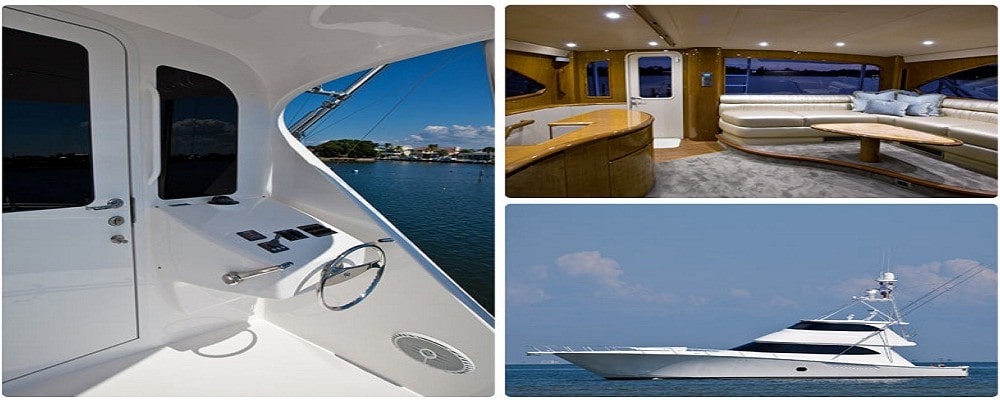
In the world of sportfishing, three names stand as the absolute titans of the industry: Bertram, Viking, and Hatteras.
For buyers in Miami, the Bahamas, and beyond, choosing between these legends is rarely a matter of good vs. bad. They are all elite. Instead, the choice is a battle of philosophy. It is a decision between speed and stability, between lightweight agility and heavy-duty durability, and between a boat built to win high-stakes tournaments and a boat built to cross oceans in any weather.
If you are currently browsing Bertram yachts for sale, or perhaps finding yourself torn between a vintage Bertram 54, a Viking 55, and a Hatteras GT series, you need more than just a glossy brochure. You need the unvarnished truth about how these hulls perform when the Gulf Stream turns nasty, and the winds kick up to 25 knots.
As your trusted experts at Miami International Yacht Sales, we are breaking down the Big Three to help you decide which legend belongs at your dock.
The Contenders: A Brief History of American Muscle
Before we compare the ride quality and technical specs, we must understand the DNA of these builders. Each brand was born from a specific need, and that heritage still dictates how they build boats today.
Bertram Yachts: The Sea Warrior
Founded by Dick Bertram after the legendary 1960 Miami-Nassau race, Bertram boats are famous for one thing above all else—the Deep-V hull. Ray Hunt’s revolutionary design changed boating forever, creating a vessel that could slice through rough water at speed rather than pounding over it.
- The Philosophy: Function First. A Bertram is built to get you home safely when other boats turn back. They are often called Sea Warriors because they prioritize a soft ride in bad weather over unmatched top speed.
- Current Status: After a period of Italian ownership under the Ferretti Group, Bertram is now owned by the Gavio Group and has returned to its American roots with production in Tampa, Florida.
Viking Yachts: The Tournament King
Viking is the undisputed king of the modern tournament circuit. If you walk the docks of a major billfish tournament in iconic locations like Isla Mujeres or Bermuda, you will see more Vikings than any other brand.
- The Philosophy: Performance and Luxury. Viking builds fast, agile, and impeccably finished machines designed to get you to the fishing grounds first. They use advanced composite materials to shed weight and gain speed.
- The Vibe: They are the Ferrari of the sportfish world—aggressive, fast, and constantly evolving.
Hatteras Yachts: The Ocean Tank
Born in the notoriously rough waters off Cape Hatteras, North Carolina, these boats earned a reputation early on for being “bulletproof.” Hatteras hulls are typically heavier, wider, and built with solid fiberglass bottoms.
- The Philosophy: Comfort and Volume. A Hatteras is often built like a tank. They prioritize massive interior volume, stability at anchor, and a ride that feels substantial.
- The Vibe: They are the Bentley of the sea—quiet, smooth, and incredibly solid.
#1: The Ride and Hull Performance
This is the most critical factor for our clients. How does the boat feel under your feet when you are running 30 knots in 4-foot seas? The difference comes down to Deadrise and Hull Geometry.
The Bertram Deep-V Advantage
The magic of Bertram yachts lies in the transom deadrise. Classic models like the Bertram 31 and the legendary Bertram 54 feature a sharp angle (often 24 to 26 degrees) carried all the way to the stern.
- The Head Sea Performance: In a head sea (waves coming directly at the bow), a Bertram is unbeatable. The sharp bow and deep stern slice through the wave face. If you frequently cross from Miami to Bimini or West End, you know that the Gulf Stream can stack up quickly. A Bertram will run through this chop with a soft entry, saving your back and your knees.
- The Trade-off: That deep V makes the boat more tender at rest. In a beam sea (waves hitting the side) or while drifting for swordfish, a classic Bertram can roll more than its flatter competitors.
The Viking Performance Plane
Viking hulls are a hybrid engineering marvel. They use a sharp entry to cut water but rely on a specialized aft planing surface to generate lift.
- Riding On Top: Unlike a heavy Hatteras that plows through the water, a Viking is designed to get up and ride on top of it. This reduces drag and increases speed. A modern Viking 55 can cruise at 35+ knots, leaving most others in its wake.
- Handling: Vikings are known for their agility. They back down on fish faster than almost anything else in their class. The trade-off is that the lighter, cored hulls can sometimes be noisier at anchor (hull slap) compared to the solid fiberglass thickness of an older Hatteras or Bertram.
The Hatteras Modified-V Stability
Hatteras typically utilizes a modified-V hull with a sharper entry at the bow that transitions to a much flatter section at the stern (transom).
- The Stability King: Because they are flatter at the stern, a Hatteras is incredibly stable. When you are trolling at 8 knots or drifting with live bait, a Hatteras sits like a concrete island. This makes them a favorite for families and guests who may be prone to seasickness.
- The Weight Factor: Hatteras boats are heavy. This weight helps crush smaller chop, giving them a majestic, plow-through-anything feel. However, in a steep, large head sea, that flatter stern can sometimes land harder than a deep-V Bertram.
#2: Construction Philosophies (Solid vs. Cored)
When you look at Bertram yachts for sale, you are often looking at a boat that has survived decades of saltwater use. That is no accident, but technology has changed.
Bertram: The Evolution
Bertram boats’ history is a tale of two eras.
- The Classic Era (1960s-1990s): These boats were built like tanks with massive amounts of resin and glass. They are heavy and solid.
- The Modern Era (2015-Present): Under the Gavio Group, modern Bertrams use advanced vacuum infusion techniques that rival the best in Europe. They have managed to blend the solid feel of the old boats with the weight savings of modern composites.
Broker Alert: The Ethanol Fuel Tank Issue. If you are buying a vintage Bertram boat (specifically gas models from the 1960s to mid-1980s), you must inspect the fuel tanks.
The Problem: Bertram (and Hatteras) used fiberglass fuel tanks. Modern ethanol-blended gasoline dissolves the resin in these old tanks. This dissolved goo gets sucked into the engine, causing catastrophic failure (bent valves, seized pistons).
The Fix: If the boat still has original fiberglass tanks and runs on gas, budget $15,000 – $30,000 to cut up the deck and replace them with aluminum tanks. Diesel fuel does not cause this issue, so diesel vintage Bertrams are generally safe.
Viking: The High-Tech Composite
Viking embraces modern technology to achieve speed. They utilize vacuum-bagged composite construction with balsa or foam coring in the hull sides and running surfaces.
- The Science: By sandwiching a lightweight core between layers of fiberglass and sucking out excess resin with a vacuum, they create a hull that is incredibly stiff and light.
- The Result: This is why a 60-foot Viking can hit 40 knots while a 60-foot Hatteras might top out at 32 knots.
- The Caution: Cored hulls require knowledgeable maintenance. You must ensure that any holes drilled into the hull (for transducers or stabilizers) are properly sealed to prevent water from entering the core.
Hatteras: The Solid Glass Standard
For decades, Hatteras has championed solid fiberglass hull bottoms.
- No Core Below Waterline: They generally do not use core material (like balsa wood or foam) below the waterline.
- Why It Matters: This eliminates the risk of water intrusion rotting the core in the hull bottom if you hit a submerged object or if a thru-hull fitting leaks. It makes the boat heavy, but it offers the ultimate peace of mind for long-range cruisers.
#3: Head-to-Head Model Showdowns
Let’s look at specific rivalries that our clients often debate.
The Legends: Bertram 54 vs. Viking 55 vs. Hatteras 54
This is the heavyweight title fight of the used market.
- Bertram 54 (The Icon): Widely considered one of the best sea boats ever built. It has a cult following. It is wet (lots of spray), but it will run through a hurricane. The interior is smaller and more dated than the Viking.
- Viking 55 (The Game Changer): Launched in the late 90s, this boat redefined the market. It was faster and had a much more luxurious interior than the Bertram. It offers a massive cockpit and excellent mezzanine seating options (on newer refits).
- Hatteras 54 (The Convertible): The shoal draft option on many Hatteras models allows them to cruise in shallower waters (like the Bahamas banks) than the deep-draft Bertram. The Hatteras usually wins on interior volume, offering a full-beam master feel that the others lack.
The Small Giants: Bertram 31 vs. The Modern 35 Flybridge
Clients often ask: “Should I restore a classic 31 or buy the new 35?”
- Bertram 31: The legend. It has a huge cockpit but almost zero cabin comfort. It is a wet ride, but arguably the best-looking boat on the water. A full restoration can cost $200k+, but you own a piece of history.
- Bertram 35 Flybridge: The modern successor. It keeps the classic lines but adds a beamier hull (more stability), a fully enclosed luxury interior with A/C, and modern CAT diesels. It is a true yacht, whereas the 31 is a day boat.
#4: Interiors and Livability
Are you buying a fishing machine or a floating condo?
Bertram: From Utilitarian to Italian Chic
Older Bertram boat models had utilitarian interiors—Formica counters and durable teak that could handle wet anglers sitting on the sofa. However, the new generation of Bertram yachts has totally flipped this script. They now offer interiors that rival high-end European motor yachts, featuring modern fabrics, open layouts, and panoramic windows.
Viking: The Luxury Standard
Viking interiors are a masterclass in space utilization. They are luxurious, but every inch is designed with the angler in mind.
- Storage: Viking hides rod storage in sofas, tackle drawers in steps, and freezers under seats.
- Finish: The high-gloss teak or walnut joinery in a modern Viking is widely considered the industry standard for production boats.
Hatteras: The Galley Up King
Hatteras often wins the volume war. Because they carry their beam (width) far forward, the staterooms in a Hatteras often feel larger than competitors of the same length. Their “Galley Up” layouts are legendary for feeling like a salon in a luxury apartment, with large windows and domestic-sized appliances.
#5: Ownership Costs and Resale
For many of our clients, a yacht is an asset class. You want to know if you can sell it when you are ready to upgrade.
Resale Liquidity
- Viking: These boats have the highest liquidity. Because they dominate the tournament scene, there is always a buyer looking for a Viking. They sell fast and hold a predictable market value.
- Bertram: Older Bertrams (like the 31, 54, and 60) have reached classic status. They have fully depreciated and are now appreciating. A restored Bertram 31 can sell for more than it cost new in 1970. They are excellent project investments.
- Hatteras: These boats hold steady value but often take slightly longer to sell than Vikings because they appeal to a more specific “cruising/fishing” buyer rather than the mass tournament market.
Maintenance Costs
- Engine Room Access: Hatteras is famous for massive, painted, well-lit engine rooms. Mechanics love them, which can sometimes lower labor costs during service. Viking engine rooms are surgical and tight; everything fits perfectly, but access can be tighter on smaller models.
- Parts: Viking has a legendary service center in New Jersey and Florida. They can ship parts for a 20-year-old boat overnight. Hatteras also has excellent support, but as the company has changed hands, some older parts can be harder to source than Viking.
The Verdict: Which Legend is For You?
After selling hundreds of sportfish yachts, here is how we categorize these brands for our clients at Miami International Yacht Sales:
Choose a Bertram If:
- The Ride Matters Most: You want the legendary sea-keeping ability of the Deep-V to handle rough head seas.
- You Love Tradition: You appreciate the heritage of Bertram yachts history and want a vessel that commands respect in any marina.
- Project Potential: You are looking for a classic hull (like a 31 or 54) to refit and customize into a modern masterpiece.
Choose a Viking If:
- You are Competitive: You want to fish in tournaments and need the speed to get there first.
- You Want Turnkey: You prefer a newer boat with modern systems and factory support.
- You Value Speed: Cruising at 30+ knots is a non-negotiable requirement for you.
Choose a Hatteras If:
- Stability is Key: You plan to spend a lot of time anchored in the Bahamas or drifting for bottom fish.
- Cruising Comfort: You prioritize a massive interior and “house-like” comfort for your family over raw speed.
- Solid Construction: You prefer the peace of mind of a heavy, solid-glass bottom for shallow water island hopping.
Find Your Perfect Sportfish in Miami
Whether you are hunting for vintage Bertram yachts to restore, a battle-ready Viking, or a long-range Hatteras, the nuances matter.
At Miami International Yacht Sales, we do not just read the specs; we have run these boats in the canyons and crossed the streams. We know which model years have the “soft” gelcoat, which ones have the bulletproof hulls, and which engine packages to avoid.
Ready to step aboard? Browse our curated selection of Bertram yachts for sale, Viking yachts for sale, and other sportfish legends today. Let us help you find the hull that matches your horizon.
Alternatively, you can contact us at +1-305-857-8939 or bob@MiamiYS.com for an expert consultation.
Disclaimer: Yacht specifications, construction methods, and performance data vary significantly by model year and engine package. Always hire a professional marine surveyor before purchasing any vessel.

Robert Lama is the founder and principal broker of Miami International Yacht Sales, an IYBA-member luxury yacht brokerage based in South Florida. With over 13 years of experience in 100’–250′ class superyacht transactions, Robert has facilitated multi-million dollar acquisitions and new builds with leading shipyards in Italy and the Netherlands. His background in Commercial Real Estate in New York gives him a unique edge in complex yacht deal structuring and negotiation.